| The Moshe Inbar Lab |
|
Research Interests
Our main research interests are animal (in particular insects) – plant interactions from ecological and practical points of view and natural conservation.
We also have a special interest in the direct interactions between mammalian herbivores and plant-dwelling insects.
We also have a special interest in the direct interactions between mammalian herbivores and plant-dwelling insects.

Direct interactions between mammalian and insect herbivores
Large mammalian herbivores (i.e. ungulates) induce changes in the chemistry, physiology, distribution and abundance of the plants they feed on. Plant-dwelling arthropods (PDI), predominantly insect herbivores, as well as the predators and parasitoids that inhabit the plants are also affected. Such plant-mediated indirect interaction between mammals and PDI has been extensively studied. However, mammalian herbivores may also directly affect PDI by incidentally ingesting them while feeding (incidental predation). Because of their ubiquity and small size, PDI are highly vulnerable to incidental ingestion by ungulates that consume large amounts of plant material. As common as this interaction may intuitively seem, very little is known about its prevalence, importance and ecological implications (trophic cascades). We are looking at different angels of these direct interactions in various habitats animal communities.
1. Consumptive and non-consumptive effects of goats and cattle on plant-dwelling arthropods in Mediterranean habitats.
We are experimentally testing how mammalian herbivores (goats and cattle) avoid incidental consumption of unpalatable insect herbivores. We identify the variety, functional groups, feeding guiled and the phenology of consumed plant-dwelling arthropods in grasslands and in the Mediterranean maquis.
1. Consumptive and non-consumptive effects of goats and cattle on plant-dwelling arthropods in Mediterranean habitats.
We are experimentally testing how mammalian herbivores (goats and cattle) avoid incidental consumption of unpalatable insect herbivores. We identify the variety, functional groups, feeding guiled and the phenology of consumed plant-dwelling arthropods in grasslands and in the Mediterranean maquis.
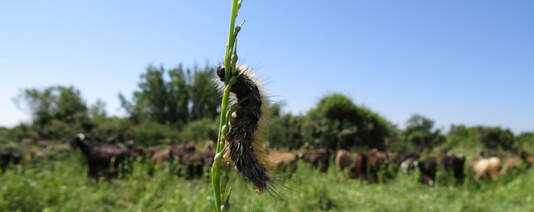
Examining goats feeding behavior when the plants are occupied by arthropods
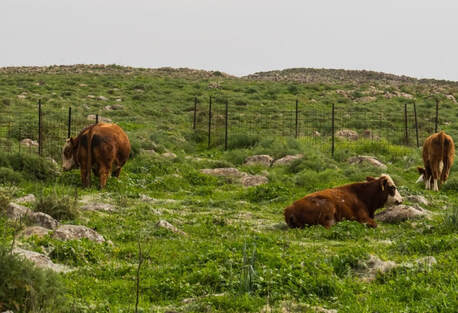
Experimental encloses in natural grazing grassland (northern Israel)
Selected publications:

| Revealing cryptic interactions between large herbivores and plant-dwelling arthropods via DNA metabarcoding |
| Cascading effects on bacterial communities: cattle grazing causes a shift in the microbiome of a herbivorous caterpillar |
| How goats avoid ingesting noxious insects while feeding |
| Immediate and long-term facilitative effects of cattle grazing on a polyphagous caterpillar |
2. The impact of mammalian herbivores on the community of plant-dwelling insects in East African savanna (MPALA, Kenya).
Kenya Long-term Enclosure Experiment (KLEE) was established more than 25 years ago in Mpala Research Centre, Kenya. Using various types of fences and managing tools, it was design to analyses the long term effects of different mammalian herbivore guilds (e.g. meso- and megaherbivores, cattle) and their combinations on the performance and composition of the plants. Hence, understand the cascading events and impacts of the different KLEE treatments down the food web. Our study focus on the effects KLEE treatments on diversity and community of plant-dwelling arthropods. The community structure of these arthropods will be constructed with metabarcoding tools based on DNA extracted from mammalian feces collected on site.
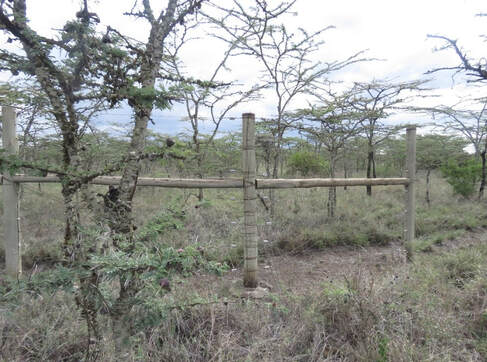
One of the KLEE treatments in the savanna (MPALA, Kenya)
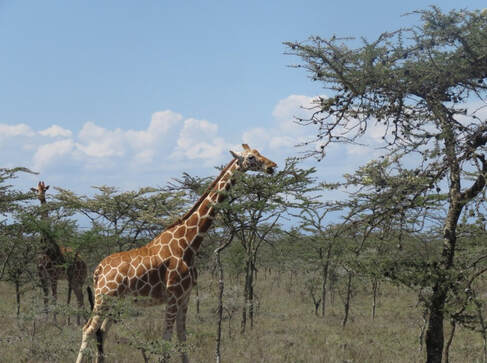
Megaherbivores in MPALA research station (Kenya)
3. Top down and bottom up trophic cascades imposed by large mammalian herbivores in grassland ecosystem (Jilin Province, northern China).
Trophic cascades are key forces in driving community structure and ecosystem functioning. Large mammalian herbivores are important components of terrestrial ecosystems and can act as potential initiator of bottom-up trophic cascades which was largely overlooked. By their consumption, feces and urine deposition, as well as physical disturbances such as trampling, large herbivores can exert strong influences on the properties of soils and plants, potentially leading to a bottom-up trophic cascade that may affect organism from higher trophic levels. On the other hand, large herbivores can have important consequences for co-occurring insects by both their consumption and non-consumption effects, potentially modifying the patterns and strength of bottom-up trophic cascades induced by these mammals.
We are setting up a large-scale grazing experiments in temperate the natural grasslands of northeastern China. The study aims to test the major hypotheses that large herbivores (cattle and sheep) can initiate a bottom-up trophic cascade to affect the abundance and diversity of co-occurring animals.
Trophic cascades are key forces in driving community structure and ecosystem functioning. Large mammalian herbivores are important components of terrestrial ecosystems and can act as potential initiator of bottom-up trophic cascades which was largely overlooked. By their consumption, feces and urine deposition, as well as physical disturbances such as trampling, large herbivores can exert strong influences on the properties of soils and plants, potentially leading to a bottom-up trophic cascade that may affect organism from higher trophic levels. On the other hand, large herbivores can have important consequences for co-occurring insects by both their consumption and non-consumption effects, potentially modifying the patterns and strength of bottom-up trophic cascades induced by these mammals.
We are setting up a large-scale grazing experiments in temperate the natural grasslands of northeastern China. The study aims to test the major hypotheses that large herbivores (cattle and sheep) can initiate a bottom-up trophic cascade to affect the abundance and diversity of co-occurring animals.
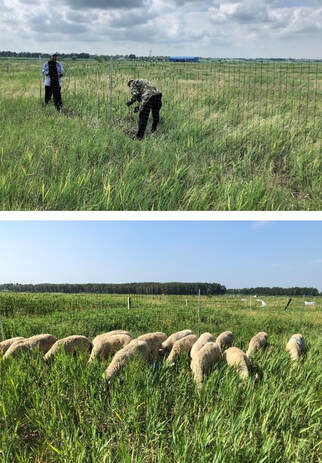
Setting up grazing experiments in natural grassland ecosystem (Jilin Province, China)
Selected publications:
| Large herbivores facilitate an insect herbivore by modifying plant community composition in a temperate grassland |

Behavioral ecology and escape response in aphids
While grazing, mammalian herbivores consume large quantities of plant material, and may incidentally ingest insects that are feeding or living on the same plant. We found that the pea aphid (Acyrthosiphon pisum) and few ladybeetles (Coccinellidae) can effectively avoid incidental ingestion by sensing the heat and humidity of the mammalian herbivore's breath and drop to the ground on time. Once they drop, the aphids lose their feeding site (host plant) and they are exposed to ground predators and desiccation. We are studding the source of variations of the willingness of aphids to drop off the plant at the individual (different ages and reproductive phase), genetics (individual, clone, biotype) and species levels. Additional focus is on the post dropping behavior and the ability of the aphids to find alternative host plant. We are also interested to use the dropping behavior as tool in pest control.
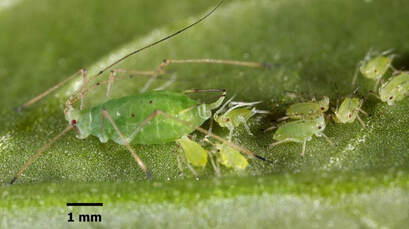
Colony of pea aphids
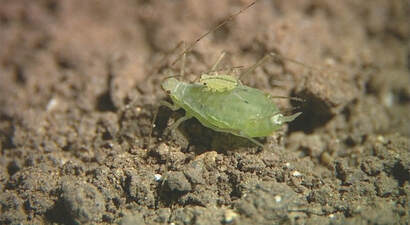
On the ground, a young pea aphid “riding” an adult on the way while searching for a new host plant
Selected publications:
| Differences in escape behavior between pea aphid biotypes reflect their host plants’ palatability |
| Mammalian herbivore breath alerts aphids to flee host plant |
| Adaptive aerial righting during the escape dropping of wingless pea aphids |
| When Herbivores Eat Predators: Predatory Insects Effectively Avoid Incidental Ingestion by Mammalian Herbivores |

Evolutionary biology and chemical ecology of gall-forming aphids
About 20 species of gall-gorming aphids (Fordini) induce galls on wild Pistachio (Pistacia spp) in Israel and the Levant. The aphids manipulate their host plant to forms galls by altering the development, anatomy, physiology and chemistry of the galled tissue. Within the galls the aphids gain protection from abiotic factors, pathogens, predators and parasitoids. They also benefit from better nutrient supply.
Our research covers various aspects of the this system:
Zoogeography and speciation of the aphids across the Middle East.
The biochemical characteristics of the gall in compared to intact leaves.
The modifications of the biochemical and molecular cascades in galled tissues.
The ecological impedance of gall traits.
The potential commercial use of gall chemicals.
Our research covers various aspects of the this system:
Zoogeography and speciation of the aphids across the Middle East.
The biochemical characteristics of the gall in compared to intact leaves.
The modifications of the biochemical and molecular cascades in galled tissues.
The ecological impedance of gall traits.
The potential commercial use of gall chemicals.
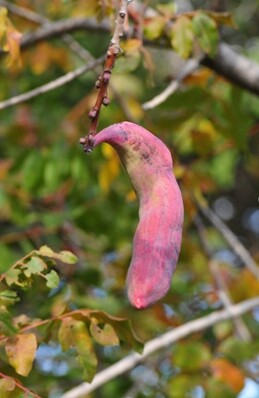
Banana-shape galls induced by the aphid Baizongia pistaciae on Pistacia palaestina
Selceted publications:
| Why do many galls have conspicuous colors? A new hypothesis |
| Transcriptional up-regulation of host-specific terpene metabolism in aphid-induced galls of Pistacia palaestina |
| Differences in Monoterpene Biosynthesis and Accumulation in Pistacia palaestina Leaves and Aphid-Induced Galls |
| Gall‑forming aphids are protected (and benefit) from defoliating caterpillars: the role of plant‑mediated mechanisms |
| Interspecific Competition among Phloem-Feeding Insects Mediated by Induced Host-Plant Sinks |

Evolutionary ecology of gall forming wasps and midges on Oaks
Israel is the most southernmost distribution range for five oak species in the Middle East: Q. ithaburensis, Q. libani and Q. cerris, Q. calliprinos Q. boissieri. These trees serve as hos for a a wide variety of gall forming wasps (Cynipidae) and midges (Cecidomyiidae). Some of them, especially the wasps induce remarkable galls.
We are looking at different aspects of these insect-plant relationships:
Identifying the species involved and their distribution and their phylogenetic position.
Clarify their life cycle, reproductive success, their natural enemies and the community of inquilines that use the galls.
Understanding the not arboreal phase of the galls once they fall (with the insect within) to the ground.
We are looking at different aspects of these insect-plant relationships:
Identifying the species involved and their distribution and their phylogenetic position.
Clarify their life cycle, reproductive success, their natural enemies and the community of inquilines that use the galls.
Understanding the not arboreal phase of the galls once they fall (with the insect within) to the ground.
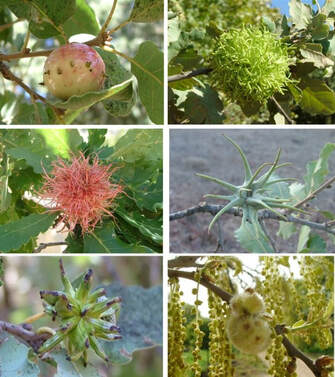
Example of galls induced by wasps on oaks in Israel. Currently 53 species were identified.
Selceted publications:
| The oak gall wasps of Israel (Hymenoptera, Cynipidae, Cynipini)—diversity, distribution and life history |
| Taxonomy and biology of Andricus morula, a new gall-wasp species from Mt Hermon, Israel |
